
Caring for geraniums is straightforward once you know what they actually need, and what to avoid. This guide covers everything: how often to water geraniums, how to fertilize without killing the blooms, when to prune, and how to store geraniums over winter so they come back strong next season.
The care information provided in this section represents the kind of practical advice is available for all the plants in this web site if you subscribe to the monthly customized newsletter Yardener’s Advisor.
 |
How Often Should You Water Geraniums?
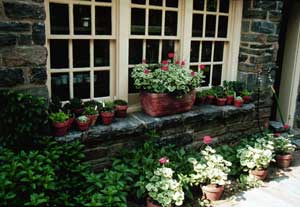
Geraniums are able to withstand some dryness. In fact, it is important not to over-water them, especially cuttings and young plants. To avoid root rot, water them only when the soil around them begins to dry out. Watch those geraniums in clay containers in the hot sun. They are likely to dry out faster than those in the garden. If possible water by hand or drip system to avoid wetting the blossoms. They deteriorate quickly when soaked.
How to Fertilize Geraniums (and What to Avoid)
Sprinkle a teaspoon or so of a general-purpose slow-acting granular fertilizer around each geranium in the spring when they you plant them outdoors in the soil. They are light feeders and this will serve their basic needs all season. Do not use manure or other rich organic soil additives which will cause the geraniums to produce excessive foliage and few flowers.
If you are planting in containers and have not mixed a slow acting fertilizer product in the potting mix at planting time, remember to feed your geraniums with liquid fertilizer periodically when you water them over the season. Follow the label instructions for amounts and frequency.
Should You Mulch Around Geraniums?
Spread a 2 or 3 inch layer of some attractive organic material such as wood chips, chopped leaves, dried grass clippings or shredded bark around geraniums planted in the yard. This will maintain soil moisture and reduce weed problems. It will also improve the soil as it gradually decomposes over the season by adding water-holding organic matter. For more information see the file on Using Mulch
 |
How and When to Prune Geraniums?
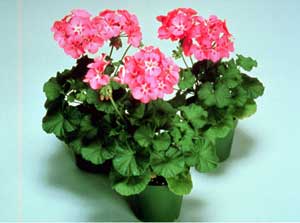
After geranium plants flower, remove faded flower heads, their stems and any yellowed leaves promptly. Regularly pinch or cut back long stems to encourage the plant to become bushy and compact. Floribunda types are naturally more compact.
Zonal geraniums can be trained to grow as a small tree. Start with a rooted cutting (see below) or young seedling from which all side shoots have been removed. Plant in a 6 inch pot and insert a stake along the single central stem. As they appear, systematically remove all side shoots and buds promptly. Do not remove any leaves, though. When the stem reaches 2 1/2 to 3 1/2 feet, pinch off its tip to encourage from 3 to 5 side branches to develop. When each side branch is 4 to 6 inches long pinch it to make the tree "top" even bushier. Water and fertilize as recommended above.
How to Store Geraniums Over Winter (2 Methods)
Geranium plants can be stored indoors over the winter two ways. (1.) Cut back them back severely, pot them and enjoy them as houseplants in a sunny window or under lights. (2.) An alternative is to dig them up and shake any loose soil from their roots. Hang the plants upside down in a cool, humid storage area such as a basement or garage. They will brown and dry out. When spring arrives, take them down and prune them back to the main stems where new green growth will be evident. Replant them outdoors after last frost and water well.
If your geraniums are struggling, see our guide on Solving Geranium Problems.
How Do You Care for Geraniums? (The Short Answer)
Geranium care comes down to four consistent habits - water only when the soil starts to dry out, fertilize lightly with a slow-release granular feed (never manure), prune after every bloom cycle, and store them properly before the first frost. Get those right and geraniums will reward you all season long. Still seeing problems? Our Solving Geranium Problems guide has the answers.
